
Shopify is best for building a long-term brand with full control. Amazon is best for selling quickly with built-in traffic. Your choice depends on whether you want ownership or reach.
In 2026, eCommerce sellers face a clear decision: sell on your own Shopify store or list on Amazon’s marketplace. Each platform has strengths. Each comes with trade-offs.
This blog helps you choose the right one for your business goals, budget, and selling style.
Key Takeaways from This Guide
- Shopify gives you full control over branding, pricing, and customer data
- Amazon offers instant access to 300M+ buyers, but takes more fees and owns the customer
- Shopify is better for profit margins and SEO
- Amazon is better for product discovery and fulfillment speed
- Many sellers combine both platforms for a multichannel strategy
Why Does This Matter in 2026?
- 56% of consumers start their product searches on Amazon rather than search engines (Jungle Scout Consumer Trends Report).
- Shopify powers over 4.8 million online stores worldwide, making it one of the most widely used ecommerce platforms for independent brands (BuiltWith / Shopify ecosystem data).
- Amazon sellers typically pay around 25–35% in combined referral and fulfillment fees per sale, depending on product category and fulfillment method (Amazon Seller Central fee structure).
- Brands that own their customer data through channels like email and SMS marketing generate significantly higher repeat purchases and customer lifetime value (Klaviyo ecommerce benchmark reports).
- Shopify sellers have full access to SEO, retargeting, and conversion rate optimization tools, allowing them to control traffic acquisition and customer relationships more effectively (Shopify platform capabilities and marketing integrations).
If you’re planning to launch a product, scale a brand, or switch platforms, this guide gives you the full picture. You’ll get direct comparisons, real examples, and practical insights to help you decide.
At StarterX, we are a full-service e-commerce agency that has helped build and scale multiple online stores for clients across different platforms. Through our experience working with e-commerce brands, we understand what actually drives growth, sales, and long-term success.
Let’s dive into the core differences between Shopify and Amazon.
What Is the Main Difference Between Shopify and Amazon?
Shopify is a platform to build your own online store. Amazon is a marketplace where you list products alongside millions of other sellers. The core difference lies in ownership, control, and customer access. If you’re new to ecommerce and planning your launch strategy, understanding the fundamentals of starting a Shopify store can help you build a brand-focused online business from the beginning.
When you sell on Shopify, you create a standalone website, manage the entire customer journey, and build a brand you fully own. On Amazon, you plug into an existing ecosystem with built-in traffic, but you compete for attention and follow Amazon’s rules. Sellers who want to grow on Amazon typically rely on structured planning and logistics, which is why many entrepreneurs first create a strategic Amazon business plan before launching their products on the marketplace.
Key Differences at a Glance
| Feature | Shopify | Amazon |
| Platform Type | Hosted eCommerce website builder | Online product marketplace |
| Brand Ownership | Full (store, domain, data) | Limited (Amazon controls customer data) |
| Traffic Source | Self-generated (ads, SEO, email) | Marketplace-driven (organic + ads) |
| Customer Data Access | Full (emails, behavior, CRM) | Restricted (no direct email access) |
| Design Control | Fully customizable | Minimal (limited to product pages) |
| Competition | SERP-level, not on the same store | Competing products shown together |
What Does This Mean for Sellers?
- Shopify gives you control over your store’s look, feel, and customer experience. You manage how products are shown, how users check out, and how data is collected.
- Amazon gives you traffic, but limits how much control you have. Customers buy through Amazon, not from your brand directly. Your listings sit next to competitors, often leading to price pressure.
- If you want to own the brand experience, Shopify is the better choice. If you want to be discovered quickly and sell quickly, Amazon has the advantage.
When Do These Differences Matter Most?
- You’re launching a long-term brand → Shopify gives you ownership
- You want to test products fast with minimal setup → Amazon is faster
- You plan to do content marketing or SEO → Shopify supports that fully
- You need access to repeat customers → Only Shopify gives full customer data
These differences shape every part of your eCommerce business—from marketing and pricing to logistics and growth.
Which Platform Offers Higher Profit Margins in 2026?
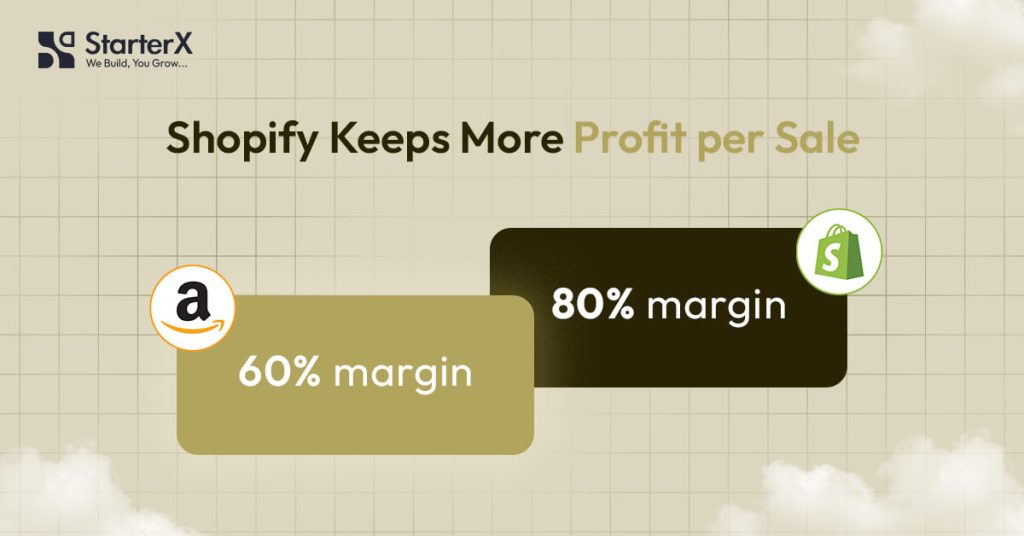
Shopify offers higher profit margins than Amazon in 2026 due to lower selling fees and full control over pricing and marketing costs. Amazon takes a larger share through referral fees, fulfillment costs, and advertising expenses.
Profit margin is a critical factor for any e-commerce seller. The platform you choose directly impacts how much profit you keep from each sale. Shopify favors margin retention, while Amazon prioritizes sales volume.
Fee Structure Comparison: Shopify vs Amazon
| Cost Type | Shopify | Amazon |
| Platform Fee | $39/month (Basic Plan) | $39.99/month (Professional Plan) |
| Transaction Fees | 0%–2% (varies by payment setup) | Included in referral fees |
| Referral Fees | None | 8%–20% per sale (avg. ~15%) |
| Fulfillment Fees | Custom (own 3PL or SFN) | ~$3.22+ per unit (FBA) |
| Advertising Costs | Flexible (Meta, Google, etc.) | Competitive (Amazon PPC bidding) |
| Total Estimated Fees | 2%–5% per sale | 20%–35% per sale |
Why Shopify Margins Are Higher
- No referral fee: Shopify doesn’t charge a cut of every sale.
- Custom fulfillment: Sellers choose the most cost-effective warehouse or delivery method (e.g. 3PL, in-house, or Shopify Fulfillment Network).
- Full ad control: You can manage and scale your ad budget across multiple channels with lower acquisition costs.
- Customer retention: Shopify stores its own customer list, making it easier to drive repeat sales without paying for reacquisition.
Why Amazon Margins Are Lower
- Referral fees average 15% across categories like home, apparel, electronics, and beauty.
- FBA fees add $3 to $8 per unit, depending on size, weight, and category.
- Ad costs rising: Amazon PPC has become more competitive, increasing average CPCs.
- Limited upsell potential: No access to email or remarketing tools means fewer low-cost repeat sales.
Example Scenario: Selling a $50 Product
| Metric | Shopify Seller | Amazon Seller |
| Sale Price | $50 | $50 |
| Platform + Fulfillment | $2.50 (Shopify Payments + 3PL) | $15 (referral + FBA) |
| Ad Spend | $5 (Google/Facebook) | $7 (Amazon PPC) |
| Net Profit | $42.50 | $28 |
| Profit Margin (%) | 85% | 56% |
Margins may vary based on fulfillment provider, category, and ad strategy.
Which Platform Wins on Profitability?
- Choose Shopify if your goal is high-margin sales, long-term brand equity, and full control over costs.
- Use Amazon if you’re willing to trade margin for speed, traffic, and ease of fulfillment.
Which Platform Is Easier for Beginners in 2026?
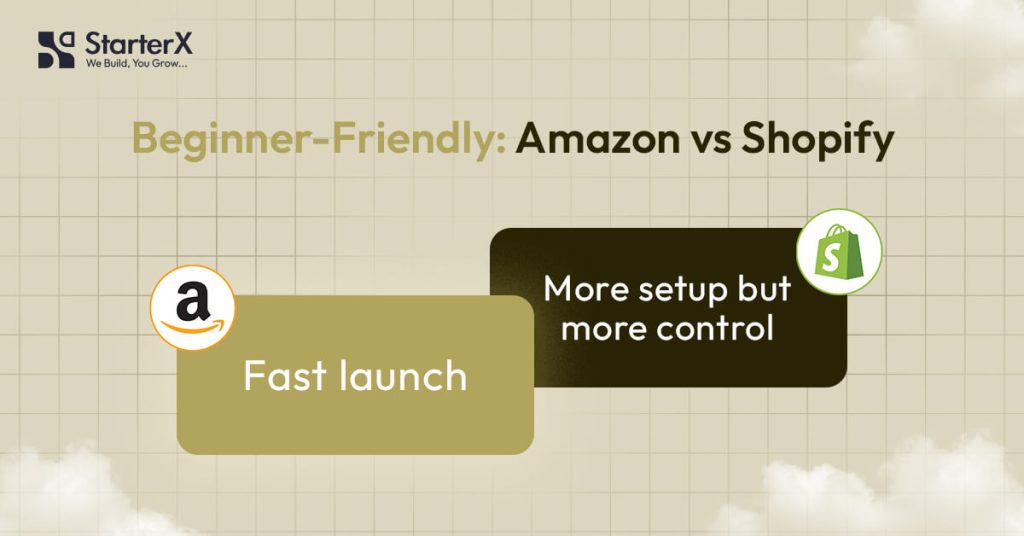
Amazon is easier for beginners in 2026 because it offers built-in traffic, simple product listing tools, and optional fulfillment through FBA. Shopify requires more setup and marketing effort but gives sellers full control from day one.
For first-time sellers, the learning curve can impact how quickly you launch and make your first sale. Choosing the right platform depends on your technical skills, marketing budget, and selling goals.
Beginner Experience Breakdown
| Factor | Amazon | Shopify |
| Store Setup | No website needed | Requires store design & configuration |
| Traffic Source | Built-in (Amazon shoppers) | You drive traffic via SEO, ads, or email |
| Product Listing | Simple ASIN-based listing | Requires custom pages or templates |
| Fulfillment Options | FBA or FBM | 3PL, in-house, or Shopify Fulfillment |
| Customer Support Tools | Amazon handles most support | You manage all customer interactions |
| Technical Skill Level | Low | Medium to high |
Why Amazon Is Easier for New Sellers
- Quick setup: You can start listing products in less than a day using existing ASINs or creating new ones.
- Fulfillment by Amazon (FBA): Handles storage, shipping, and customer service. No need to set up logistics.
- No web design: All sales happen on Amazon’s platform. No need to learn site builders or themes.
- Product exposure: You tap into over 300 million active customers without building an audience.
When Shopify Makes Sense for Beginners
- You’re launching a unique product or niche brand with long-term potential.
- You’re comfortable setting up a website or working with a Shopify expert.
- You want direct control over marketing, customer data, and checkout experience.
Shopify’s onboarding has improved with Shopify Starter Plans, AI-assisted setup, and Shopify Magic, but it still requires more hands-on work than Amazon.
Beginner Example: Selling Phone Accessories
- On Amazon: You can list a phone case under an existing ASIN, activate FBA, and start selling the same day.
- On Shopify: You’ll need to buy a domain, design a product page, set up payments, and drive your own traffic through ads or SEO.
Which Platform Should a Beginner Choose?
- Choose Amazon if you want fast setup, easier logistics, and immediate product visibility.
- Choose Shopify if you plan to build a brand from the start and want full control over your business.
Who Owns the Customer Relationship on Each Platform?
Shopify sellers own the customer relationship. Amazon sellers do not. This difference affects how you handle marketing, retention, support, and future sales.
Ownership of the customer means you control how and when you communicate. It lets you build loyalty, collect insights, and reduce dependency on paid ads. On Amazon, you sell products, but Amazon owns the buyer relationship.
Customer Access Comparison: Shopify vs Amazon
| Attribute | Shopify | Amazon |
| Customer Email Access | Full access | Not provided |
| Communication Rights | Email, SMS, retargeting | Limited to the Amazon messaging system |
| Brand Experience Control | Full (site, checkout, post-purchase) | Amazon-controlled |
| Retention Marketing | Email, loyalty programs, and remarketing | Not allowed outside Amazon |
| Customer Support Control | You handle it directly | Amazon handles it (FBA) or shared |
Why Customer Ownership Matters
- Retention: Brands that control their email list see higher lifetime value. Repeat sales don’t require ad spend.
- Brand Loyalty: You control the messaging, packaging, and post-purchase flow.
- Data Insights: Shopify gives you full access to customer behavior, purchase history, and conversion paths.
What Amazon Allows (and Restricts)
Amazon limits seller access to:
- Buyer names and shipping addresses (for fulfillment only)
- Messaging through Amazon’s platform (strict policies apply)
- No access to email, phone numbers, or off-platform remarketing
You can’t retarget Amazon buyers with ads, send newsletters, or build loyalty programs outside Amazon’s system.
Shopify’s Advantage in Relationship Marketing
Shopify supports:
- Full email list building with tools like Klaviyo or Mailchimp
- Cart abandonment recovery
- Retargeting ads on Google, Meta, and TikTok
- Personalized promotions and customer segmentation
This gives Shopify sellers control over customer acquisition, retention, and growth strategies, without relying on a third party.
Which Platform Wins on Customer Ownership?
- Choose Shopify if you want to build a loyal customer base and keep full control of your marketing channels.
- Choose Amazon if you only need access to shoppers in the short term and don’t need long-term engagement.
How Do SEO and Visibility Work Differently on Shopify vs Amazon?
Shopify gives full control over SEO for Google search. Amazon offers built-in product visibility through its internal search engine (A9). Both have ranking systems, but the way you get found by buyers is completely different.
On Shopify, you drive traffic to your site using content, backlinks, and search engine optimization. On Amazon, traffic comes from shoppers already searching within the platform, but your product must rank well against competing listings.
Search Visibility Comparison: Shopify vs Amazon
| Attribute | Shopify | Amazon |
| Search Engine Type | Google (external search) | Amazon A9 (internal search) |
| Ranking Factors | Keywords, content, backlinks, UX | Sales velocity, price, reviews |
| Metadata Control | Full (title, description, URL) | Limited to product fields |
| Content Creation | Full blogs, guides, and landing pages | Product page only |
| SEO Tools Available | SEO apps, schema markup, full access | Limited on-page optimization |
| Long-Term Value | Evergreen search traffic is possible | Requires constant performance |
How SEO Works on Shopify
- You optimize product pages, blogs, and categories for Google using keywords, structured data, and backlinks.
- With the right setup, your site can rank for terms like “eco-friendly yoga mats” or “custom phone cases.”
- You can target non-branded searches, build topical clusters, and generate passive traffic over time.
- You can use SEO tools like Yoast, Schema App, and Ahrefs to track and improve rankings.
This gives Shopify a major advantage for sellers planning to grow organically over the long term.
How SEO Works on Amazon
- Amazon uses its own A9 algorithm, which ranks products based on:
- Sales history and conversion rate
- Product title, bullet points, and backend keywords
- Pricing, Prime eligibility, and reviews
- You don’t compete in Google search. Instead, your product shows up when customers search directly on Amazon.com.
Amazon SEO is more transactional; it’s focused on getting the sale, not building content or ranking for informational searches.
Practical Example: Selling a Skincare Product
- On Shopify: You can rank a blog post like “Best skincare routine for dry skin” and link it to your product page. This builds authority and brings long-term traffic.
- On Amazon: You optimize your listing title, bullet points, and backend keywords. You must get early reviews and drive sales to improve ranking.
Which Platform Gives Better SEO Opportunities?
- Choose Shopify if you want to use Google SEO, content marketing, and long-term organic traffic.
- Choose Amazon if you want to focus on immediate product visibility through optimized listings and sales performance.
Which Platform Is Better for Brand Building in 2026?
Shopify is better for brand building because it gives you full control over your store’s design, messaging, customer experience, and marketing tools. Amazon limits how much branding you can do beyond your product listing.
If your goal is to create a recognizable and trusted brand in your niche, the platform you choose makes a major difference. Brand equity grows when you control how customers see, interact with, and remember your business.
Brand Control Comparison: Shopify vs Amazon
| Attribute | Shopify | Amazon |
| Visual Customization | Full (themes, fonts, layout, UX) | Minimal (product page only) |
| Domain and Branding | Custom domain (e.g. yourbrand.com) | Amazon.com/[ASIN] |
| Checkout Experience | Fully branded checkout process | Amazon’s default checkout |
| Email and Remarketing | Yes (owned audience) | No (Amazon controls communication) |
| Storytelling Tools | Blogs, landing pages, videos | Limited to A+ Content (with Brand Registry) |
| Customer Loyalty Programs | Full control with apps or custom code | Not supported outside the Amazon ecosystem |
How Shopify Supports Brand Building
- You design your own storefront using Shopify themes or custom code. This includes colors, fonts, layout, and interactive elements.
- You build trust through your own domain name, branded checkout, and custom thank-you pages.
- You can publish content, blogs, how-to guides, and video tutorials—to support your brand voice and educate buyers.
- You collect emails for newsletters, loyalty offers, and personalized outreach.
This gives Shopify sellers the tools to build a brand that people remember and return to.
How Amazon Limits Branding
- You sell under the Amazon brand, not your own. Buyers often remember they bought something from Amazon, not from you.
- Product pages are standardized, with little room for design.
- A+ Content is only available if you enroll in Amazon Brand Registry, and even then, the branding remains limited to product descriptions.
- You can’t control the checkout, customer follow-up, or post-purchase messaging.
Example: Branding a Premium Tea Brand
- On Shopify: You can create a homepage with lifestyle photos, health tips, video reviews, and custom packaging design. You guide the customer from start to finish in a branded journey.
- On Amazon: Your product appears next to competitors. You rely on title, bullets, and reviews to make an impression. Brand visuals are minimal, even with A+ content.
Which Platform Wins for Brand Building?
- Choose Shopify if you want to create a strong brand identity and own the customer experience.
- Use Amazon if your product competes mainly on price, reviews, or convenience—and brand loyalty is not your focus.
Which Platform Has More Competition in 2026?
Amazon has significantly more direct competition than Shopify in 2026, especially within product categories. On Amazon, your listings appear side-by-side with similar products, often leading to price wars. On Shopify, you compete in search engines, not within a shared storefront.
The way competition works on each platform affects how easily you can stand out, what pricing flexibility you have, and how much you need to invest in advertising to stay visible.
Competitive Landscape: Shopify vs Amazon
| Factor | Amazon | Shopify |
| Marketplace Saturation | High (millions of similar listings) | Low (each store is independent) |
| Product Comparison | Direct (side-by-side in search) | Indirect (via search engines or ads) |
| Price Pressure | High (due to lowest-price preference) | Flexible (you set and defend your value) |
| Visibility Strategy | Based on ranking, reviews, and price | Based on branding, SEO, and ads |
| Unique Positioning Opportunity | Low (limited page control) | High (full site control and messaging) |
Why Amazon Is More Competitive
- Over 2.5 million active Amazon sellers compete for the same buyers (Marketplace Pulse, 2025).
- Product listings are shown in search result grids, making it easy for buyers to compare prices, ratings, and shipping speed.
- Amazon often pushes its own private label products (e.g., Amazon Basics), increasing pressure on third-party sellers.
- Competing sellers can run aggressive PPC campaigns on your branded keywords.
You must constantly defend your visibility with strong reviews, optimized listings, and paid ads.
Why Shopify Allows More Differentiation
- Each Shopify store is standalone. You don’t share space with direct competitors.
- Your brand’s design, content, and product presentation help you stand out.
- You don’t need to fight in a product grid; you build your own sales funnel.
- You can position your products around values, lifestyle, or niche needs that don’t rely on discounts or volume.
This lets you build long-term value without lowering your price to win the sale.
Example: Selling Reusable Water Bottles
- On Amazon: You’re listed next to dozens of other reusable bottles, sorted by price, reviews, and Prime status. Many sellers offer nearly identical products.
- On Shopify: You create a site focused on sustainability, hydration habits, and premium design. Visitors engage with your brand—not just a product photo and price.
Which Platform Is Easier to Compete On?
- Choose Shopify if you want to build a differentiated product and control your customer journey.
- Choose Amazon if you’re prepared to compete on price, volume, and performance metrics within a saturated market.
How Do Fulfillment and Logistics Compare?
Amazon offers faster and more automated fulfillment through FBA (Fulfillment by Amazon), while Shopify gives sellers full flexibility to choose how they store, pack, and ship orders. The best choice depends on how much control you want and how quickly you need to deliver.
Fulfillment affects not just delivery speed, but also customer satisfaction, return handling, and operational costs. In 2026, sellers need to weigh convenience against control when choosing a fulfillment strategy.
Fulfillment Options: Shopify vs Amazon
| Attribute | Shopify | Amazon (FBA) |
| Fulfillment Method | In-house, 3PL, or Shopify Fulfillment | Fulfilled by Amazon (FBA) or FBM |
| Shipping Speed | Depends on provider (2–5 days typical) | 1–2 days with Prime |
| Prime Badge Availability | Not applicable | Yes, with FBA |
| Storage Fees | Based on 3PL or SFN terms | Monthly and long-term storage fees |
| Return Handling | Seller manages or automates | Amazon handles all returns |
| Branding on Packaging | Full control | No (Amazon packaging) |
Fulfillment with Shopify
- You can fulfill orders yourself, work with a third-party logistics (3PL) provider, or use Shopify Fulfillment Network (SFN).
- You control packaging, delivery partners, and shipping speeds.
- You can use branded packaging, include marketing inserts, and create a premium unboxing experience.
- Ideal for sellers focused on customer experience and cost efficiency.
Fulfillment with Amazon
- FBA handles everything: warehousing, picking, packing, shipping, and returns.
- Your products become Prime-eligible, giving you an edge in conversions and search visibility.
- You lose control over packaging, delivery branding, and post-purchase materials.
- Fees can rise based on size, weight, and storage time, especially during peak seasons.
Practical Example: Shipping 500 Orders/Month
- On Shopify: You work with a 3PL that offers 3-day shipping, branded boxes, and volume discounts. You save on fees but manage more logistics.
- On Amazon: You send bulk inventory to FBA. Amazon handles delivery in 1–2 days, but you pay higher per-unit costs and lose branding opportunities.
Which Fulfillment Option Is Better?
- Choose Amazon (FBA) if you prioritize speed, automation, and Prime visibility.
- Choose Shopify if you want brand control, flexible costs, and a custom shipping experience.
Which Platform Supports International Selling Better in 2026?
Amazon simplifies international selling with built-in infrastructure and global reach, while Shopify offers more flexibility and control for customized global expansion. Your choice depends on whether you want speed or localization.
In 2026, global e-commerce will continue to grow fast. Cross-border sales account for over 22% of total online retail sales worldwide (Statista, 2025). But selling internationally requires handling taxes, shipping, currencies, and customer expectations; each platform solves this differently.
Global Selling Comparison: Shopify vs Amazon
| Attribute | Amazon | Shopify |
| International Access | 100+ countries via Amazon Global | Unlimited (via Shopify Markets) |
| Multi-Currency Support | Auto-converted on the marketplace | Yes, with real-time FX rates |
| Localized Domains | No (amazon.com/intl) | Yes (e.g. yourbrand.co.uk, .de) |
| Fulfillment Support | FBA Global Export & Amazon warehouses | Shopify Fulfillment Network or 3PL |
| Tax/VAT Handling | Automated by Amazon | Managed via Shopify + 3rd party tools |
| Customization by Region | Limited | Full customization per region |
How Amazon Supports International Sellers
- You can use Amazon Global Selling to list in regional marketplaces like Amazon UK, Germany, Japan, or Canada.
- Amazon handles currency conversion, VAT, duties, and localized customer service.
- FBA distributes products to local warehouses, making Prime shipping available in multiple countries.
- Great for sellers who want fast access to global buyers without managing local logistics manually.
How Shopify Enables Global Expansion
- Shopify’s Markets feature allows you to set up multiple storefronts by region, each with local currency, pricing, and language.
- You can use custom domains (e.g., yourstore.fr) and localized product content for each country.
- Shopify integrates with tools like Avalara and Zonos to handle tax and duty calculations.
- You have full control over shipping options, checkout settings, and marketing campaigns per region.
Example: Expanding from the U.S. to Europe
- On Amazon: You list products on Amazon.co.uk and .de using the Global Selling dashboard. FBA stores and ships products locally, but you compete with regional sellers and have limited branding options.
- On Shopify: You launch localized EU storefronts with local pricing, translated content, and SEO-optimized product pages. You use a 3PL partner to ship across borders and maintain your brand experience.
Which Platform Wins for International Selling?
- Choose Amazon if you want a fast, low-maintenance way to reach global customers through Amazon’s existing infrastructure.
- Choose Shopify if you want full control over localization, branding, and pricing in each market.
Which Platform Is Better in 2026?
Shopify is better for sellers focused on building a long-term brand and maximizing profit margins. Amazon is better for sellers who want fast sales, built-in traffic, and simplified logistics. The right choice depends on your business goals, product type, and growth strategy.
Both platforms have proven models in 2026. But they serve different purposes—and choosing the right one means matching your needs with the platform’s strengths.
Best Platform by Business Goal
| Business Goal | Recommended Platform | Why It Works |
| Build a long-term brand | Shopify | Full control over design, data, and UX |
| Test products quickly | Amazon | Easy listing, fast traffic, low setup time |
| Maximize profit margins | Shopify | No referral fees, flexible fulfillment |
| Get access to millions of buyers | Amazon | Built-in demand and high purchase intent |
| Own customer relationships | Shopify | Direct access to emails and retention data |
| Sell internationally fast | Amazon | Automated cross-border tools via FBA |
| Run SEO and content strategy | Shopify | Blog, metadata, Google optimization |
| Scale fast with PPC | Amazon | Efficient with right bids and reviews |
| Differentiate from competitors | Shopify | Unique store design and branding options |
Seller Profile Examples
- First-time seller with no website experience? → Start with Amazon, get early traction, then expand to Shopify.
- Experienced marketer or DTC brand? → Choose Shopify for control, data, and better customer lifetime value.
- Dropshipper or niche product seller? → Shopify gives you full control over product pages and niche positioning.
- Private label product in a broad category? → Amazon gives you reach, but expect pricing pressure and high ad costs.
How Sellers’ Needs Have Shifted in 2026
- Customer acquisition is more expensive, making retention and owned channels critical. Shopify excels here.
- Amazon ad costs are higher, but conversion rates are still strong due to buyer intent.
- Fulfillment speed is now expected, and both platforms offer scalable logistics (FBA or SFN).
- Global sales are growing, and each platform supports international reach in different ways.
Final Platform Match Summary
| Seller Type | Better Platform |
| Brand-focused | Shopify |
| Budget-conscious beginner | Amazon |
| High-ticket or custom product | Shopify |
| Fast-moving consumer goods | Amazon |
| SEO and content-driven business | Shopify |
| Volume seller with tight margins | Amazon |
Final Checklist: Shopify vs Amazon Decision Factors
Choosing between Shopify and Amazon in 2026 depends on your goals, resources, and selling style. Use this checklist to match your situation with the right platform—or confirm if a hybrid approach fits best.
Key Considerations Before You Choose
- Do you want to own customer data and build long-term loyalty? → Shopify is stronger.
- Do you prefer a fast setup with built-in traffic? → Amazon makes that easier.
- Are profit margins and cost flexibility a priority? → Shopify helps retain more per sale.
- Do you plan to use SEO, blogging, or content marketing? → Shopify gives you the tools.
- Would you rather have logistics handled for you? → Amazon’s FBA system is unmatched.
- Are you selling high-demand or commodity products? → Amazon offers instant reach.
- Do you value branding, storytelling, and control of packaging? → Shopify provides customization.
- Do you want to test products quickly with minimal setup? → Amazon gets you there faster.
- Is your goal to scale globally with multiple channels? → Using both platforms together is often the most effective.
Making the right choice comes down to clarity: do you want reach, ownership, or both? In 2026, the most successful sellers know how to align platform strengths with their business model.
Ready to Grow Your Amazon or Shopify Business?
StarterX is an experienced eCommerce agency that has scaled multiple Amazon stores and Shopify stores to long-term success. We provide expert Amazon seller services to increase visibility and tailored Shopify store services to build powerful brands.
Book a free consultation today and see how StarterX can help you succeed on Amazon, Shopify, or both.
Frequently Asked Questions About Selling on Shopify vs Amazon
Is Shopify cheaper than Amazon for sellers?
Yes. Shopify typically costs less per sale because it avoids Amazon’s referral fees, which average 15%. Sellers on Shopify mainly pay a monthly subscription and payment processing fees, keeping a higher profit margin overall.
Can you sell on Amazon without Shopify?
Yes. You can sell directly on Amazon using a Professional Seller Account. Shopify is not required. Many sellers start on Amazon alone, then add Shopify later for branding and customer retention.
Can Shopify integrate with Amazon?
Yes. Shopify integrates with Amazon through apps like Codisto or Sellbrite. This allows sellers to sync product listings, inventory, and orders between both platforms, making it easier to run a hybrid eCommerce strategy.
Which platform is better for beginners, Shopify or Amazon?
Amazon is easier for beginners because setup is quick, traffic is built in, and Fulfillment by Amazon handles shipping. Shopify requires more setup and marketing but gives better long-term control and branding opportunities.
Who owns customer data on Amazon vs Shopify?
On Shopify, the seller owns full customer data, including email addresses, purchase history, and behavior insights. On Amazon, sellers cannot access customer emails or build direct marketing lists. Amazon controls the customer relationship.
Is Amazon or Shopify better for international selling?
Amazon makes global selling easier through Amazon Global Selling and FBA’s international warehouses. Shopify supports international growth with Shopify Markets, localized domains, and multi-currency options, but requires more setup by the seller.
Can you make more money on Shopify or Amazon?
Sellers usually keep higher margins on Shopify due to lower fees. Amazon provides faster access to buyers but takes a larger cut through referral and FBA fees. Profitability depends on business model, product type, and strategy.

The StarterX Team is a group of e-commerce experts with years of hands-on experience in launching, managing, and scaling online businesses. As trusted authorities in the e-commerce space, we’ve helped entrepreneurs grow successful stores on Amazon, Shopify, TikTok, and Walmart. Backed by real-world results and a data-driven approach, we deliver proven strategies and insights you can trust to succeed in the digital marketplace.