

.svg)
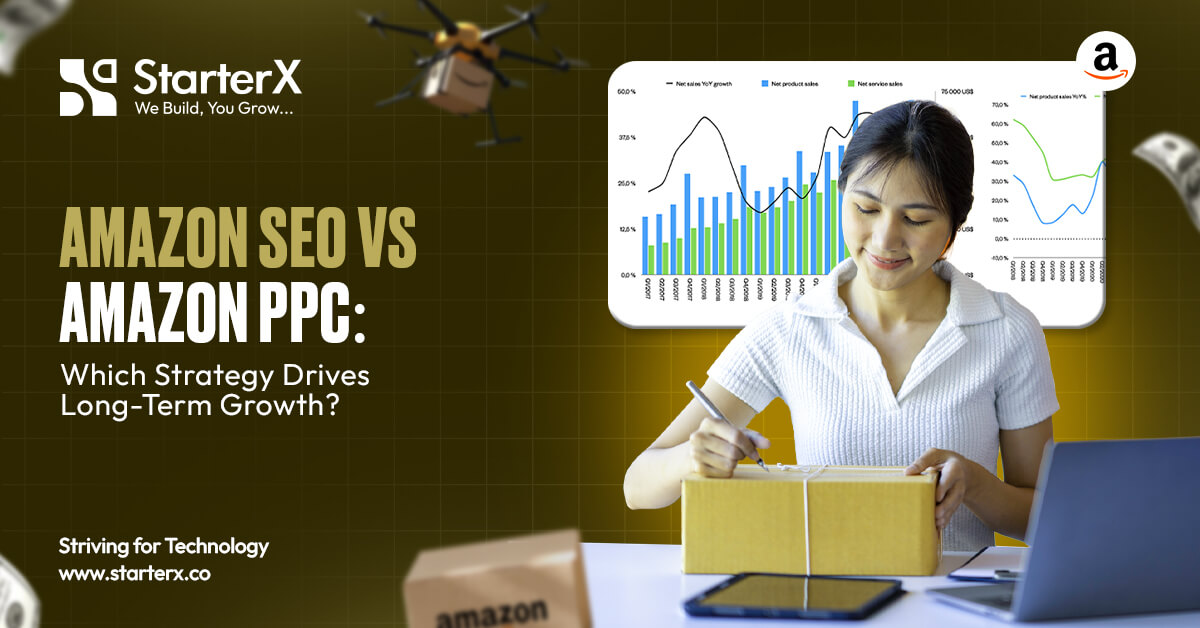
Amazon SEO and Amazon PPC both help sellers grow on Amazon, but they work differently. Amazon SEO improves organic visibility through listing optimization, keyword indexing, relevance, CTR, conversion rate, reviews, pricing, and sales history. Amazon PPC gives faster paid visibility through Sponsored Products, Sponsored Brands, Sponsored Display, keyword targeting, bids, budgets, and campaign control.
Amazon PPC is faster, but SEO builds stronger long-term growth. The best strategy is usually to use both. PPC brings traffic, sales data, and search term insights. SEO uses that data to improve organic ranking, listing quality, and long-term sales.
What You Will Learn in This Blog
In this blog, you will learn:
- What Amazon SEO and Amazon PPC mean
- The main differences between SEO and PPC
- Which strategy gives faster results
- Which strategy supports long-term growth
- How PPC supports SEO
- How SEO improves PPC performance
- When to focus on SEO, PPC, or both
- Which metrics to track for better decisions
- Common mistakes sellers should avoid
Key Takeaways
- Amazon SEO builds organic ranking through relevance, indexing, listing quality, reviews, pricing, and conversion signals.
- Amazon PPC drives faster traffic through paid ads, bids, targeting, budgets, and campaign reports.
- PPC does not directly guarantee organic ranking, but it can support SEO through traffic, sales, and keyword data.
- SEO can improve PPC results because better listings usually convert more clicks into sales.
- New products often need both because SEO prepares the listing and PPC brings early visibility.
- TACoS matters with ACoS because it shows how ads affect total sales and ad dependency.
- The strongest Amazon strategy combines PPC traffic with SEO growth.
Amazon SEO vs Amazon PPC: Quick Comparison
| Factor | Amazon SEO | Amazon PPC |
| Purpose | Improve organic ranking | Drive paid traffic |
| Visibility | Organic search results | Sponsored placements |
| Cost | No direct cost per click, but optimization takes work | Pay-per-click ad spend |
| Speed | Slower, builds over time | Faster after campaigns go live |
| Control | Less direct ranking control | More control through bids, budgets, and targeting |
| Main focus | Indexing, relevance, CTR, CVR, reviews, sales history | CPC, ACoS, ROAS, TACoS, search terms, bids |
| Best for | Long-term growth | Launches, testing, faster visibility |
| Long-term value | Strong compounding value | Strong traffic and data, but spend-dependent |
Why Amazon SEO and Amazon PPC Matter
Amazon is a search-driven marketplace. If your product does not appear for the right search terms, shoppers may never find it. SEO helps your product earn organic visibility, while PPC helps it appear in paid placements faster.
Amazon Ads reports that sellers using Sponsored Products saw 34% more sales growth on average than those who did not, four weeks after adoption. This shows the value of paid visibility, but PPC only works well when the listing is ready to convert. Weak images, poor keywords, low reviews, unclear bullets, or bad pricing can still waste ad spend.
That is why SEO and PPC should work together.
Why Trust This Guide?
At StarterX, we work as a full-service Amazon agency helping sellers improve both Amazon SEO and Amazon PPC performance. We manage listing optimization, keyword research, Sponsored Products, Sponsored Brands, Sponsored Display, campaign structure, search term analysis, ACoS, ROAS, and TACoS for Amazon sellers at different growth stages.
This guide is based on real Amazon growth work. It explains when to use SEO, when to use PPC, and how both strategies can support long-term Amazon sales.
What Is Amazon SEO?
Amazon SEO is the process of improving a product listing so Amazon can understand, index, and rank it for relevant shopper searches. It helps your product appear in organic search results without paying for each click. Amazon SEO depends on keyword relevance, listing quality, CTR, conversion rate, reviews, pricing, stock availability, and sales history.
A strong Amazon SEO strategy is not only about adding keywords. It makes the full product detail page clear, relevant, and conversion-ready.
1. Product Listing Optimization
Product listing optimization means improving the main parts of your Amazon product page, including:
- Product title
- Main image and lifestyle images
- Bullet points
- Product description
- Backend search terms
- A+ Content
- Product attributes
- Pricing and offers
The goal is to help Amazon understand the product and help shoppers decide faster. A good listing includes relevant keywords, clear benefits, strong images, and useful product details without keyword stuffing.
2. Keyword Indexing and Relevance
Keyword indexing means Amazon has connected your product with a search term. If your product is not indexed for a keyword, it is harder to rank for that keyword organically.
Relevance comes from your title, bullets, backend search terms, category, product attributes, and customer behavior. The best keywords match the product and shopper intent.
For example, if you sell a stainless steel water bottle, terms like insulated water bottle, metal water bottle, and water bottle for gym are more relevant than a broad term like kitchen accessories.
3. Organic Ranking and Conversion Signals
Organic ranking is where your product appears in unpaid Amazon search results. Ranking is influenced by relevance and performance.
Key signals include:
- CTR
- Conversion rate
- Sales history
- Reviews and ratings
- Price competitiveness
- Stock availability
- Product relevance
If shoppers click but do not buy, the listing may struggle to grow organically. This is why Amazon SEO and conversion rate work together.
4. Review Quality, Pricing, and Sales History
Reviews, pricing, and sales history affect shopper trust and buying decisions. A product with strong reviews, fair pricing, and steady sales usually has a better chance of converting traffic.
Amazon SEO works best when the product offer is strong. Better images, clear bullets, honest reviews, competitive pricing, and consistent stock can all support stronger organic visibility over time.
What Is Amazon PPC?
Amazon PPC is a paid advertising model where sellers pay when shoppers click their ads. It helps products appear in sponsored placements across Amazon search results and product detail pages. A stronger Amazon PPC strategy gives sellers more control through keywords, ASIN targets, bids, budgets, match types, placements, and campaign reports.
PPC is useful when you need faster visibility, keyword testing, launch traffic, or more control over where your product appears. Understanding the different Amazon ad formats also helps sellers choose the right campaign type based on product stage, goal, and budget.
1. Sponsored Products
Sponsored Products promote individual product listings and send shoppers directly to the product detail page. They are often the first PPC ad type sellers use because they are sales-focused and easy to connect with keyword targeting.
They can use:
- Automatic targeting
- Manual keyword targeting
- Product targeting
- Broad, phrase, and exact match types
- Negative keywords
- Placement adjustments
Sponsored Products work best when the listing is already ready to convert. Weak images, unclear bullets, poor pricing, or low trust can turn paid clicks into wasted spend.
2. Sponsored Brands
Sponsored Brands promote a brand, product collection, Store, or video creative. They are useful for brand visibility, category awareness, branded searches, and showing multiple products together.
This ad type works best for sellers with Brand Registry, a clear brand message, and enough products to promote. It is often stronger for growth-stage and mature brands than for sellers with only one new listing.
3. Sponsored Display
Sponsored Display helps sellers reach shoppers through product targeting, audience targeting, and remarketing-style placements. It can support visibility on product detail pages, competitor ASINs, and related product pages.
This ad type usually works better after a product has some traffic, sales data, and a stronger listing. For many sellers, Sponsored Products come first, and then Sponsored Brands and Sponsored Display can support wider growth.
4. Keyword Targeting, Bids, and Campaign Control
Amazon PPC gives more direct control than Amazon SEO. Sellers can choose keywords, ASIN targets, match types, bids, budgets, negatives, and placements.
Important PPC metrics include:
- CPC
- CTR
- Conversion rate
- ACoS
- ROAS
- TACoS
- Search term performance
The goal is not just to get clicks. The goal is to turn relevant clicks into profitable sales. PPC can bring fast data, but it needs proper keyword research, bid control, negative keywords, and a listing that can convert.
Amazon SEO vs Amazon PPC: Key Differences
The main difference between Amazon SEO and Amazon PPC is how visibility is earned. Amazon SEO helps products rank organically through relevance, indexing, listing quality, conversion rate, reviews, pricing, and sales history. Amazon PPC helps products appear in sponsored placements through paid ads, keyword targeting, bids, budgets, and campaign control.
Both strategies can increase sales, but they work at different speeds and require different types of management.
| Factor | Amazon SEO | Amazon PPC |
| Visibility source | Organic search results | Sponsored ad placements |
| Cost structure | No direct cost per click, but optimization takes work | Pay-per-click ad spend |
| Speed of results | Slower, builds over time | Faster after campaigns go live |
| Control level | Less direct control over ranking | More control through bids, budgets, and targeting |
| Data quality | Organic rank, indexing, CTR, CVR, and sales trends | Search terms, CPC, ACoS, ROAS, TACoS, bids, and placement data |
| Long-term impact | Stronger compounding value | Strong traffic and testing value, but it depends on ad spend |
1. Visibility Source
Amazon SEO earns visibility in organic search results. Your product appears because Amazon sees it as relevant and likely to convert for a shopper’s search.
Amazon PPC gives visibility through sponsored placements. Your product can appear in paid positions in search results, product pages, and other ad placements based on targeting, bids, budget, and ad relevance.
2. Cost Structure
Amazon SEO does not charge you for each organic click. But it still needs investment in keyword research, listing optimization, images, A+ Content, testing, and ongoing improvements.
Amazon PPC charges when someone clicks your ad. This means every click has a cost, so campaign structure, keyword targeting, bid control, and conversion rate matter a lot.
3. Speed of Results
Amazon PPC is usually faster because ads can start getting impressions and clicks after campaigns are active.
Amazon SEO takes longer because organic ranking depends on indexing, relevance, click-through rate, conversion rate, reviews, pricing, stock availability, and sales history.
4. Control Level
Amazon PPC gives more direct control. You can choose keywords, ASIN targets, match types, bids, budgets, negative keywords, and placements.
Amazon SEO gives less direct control because organic ranking is earned over time. You can improve the listing and product performance, but you cannot directly choose your organic position.
5. Data Quality
Amazon PPC gives clearer performance data through search term reports, targeting reports, CPC, ACoS, ROAS, TACoS, and placement data. This helps sellers see which keywords bring clicks and sales.
Amazon SEO data is useful but less direct. Sellers need to track keyword ranking, indexing, organic sales, CTR, conversion rate, and total sales trends.
6. Long-Term Impact
Amazon SEO has stronger long-term value because a better organic ranking can keep bringing sales without paying for every click.
Amazon PPC is powerful for traffic, launches, testing, and scaling, but it is spend-dependent. Once ads stop, paid visibility also stops.
Which Strategy Gives Faster Results: Amazon SEO or Amazon PPC?
Amazon PPC gives faster results because ads can start showing after campaigns go live. It can bring impressions, clicks, keyword data, and sales much faster than organic SEO. Amazon SEO takes longer because organic ranking builds through relevance, indexing, CTR, conversion rate, reviews, pricing, and sales history.
But faster does not always mean better. PPC can bring traffic quickly, but the listing still needs to convert that traffic into sales.
Amazon PPC is usually faster when:
- You are launching a new product
- You need traffic quickly
- You want to test keywords
- You need search term data
- You want visibility in a competitive category
- Your listing is already conversion-ready
Amazon SEO is slower because Amazon needs time to understand your product and measure how shoppers respond to it. A listing must prove that it is relevant and useful for specific search terms.
Amazon SEO usually takes more time because it depends on:
- Keyword indexing
- Listing relevance
- Click-through rate
- Conversion rate
- Review quality
- Price competitiveness
- Sales history
- Stock availability
For example, a new product with no sales history may struggle to rank organically for a high-volume keyword. PPC can help that product appear for relevant searches sooner. If shoppers click and buy, the seller gets useful keyword and conversion data.
Still, PPC should not be used as a shortcut for a weak listing. If your images are poor, your title is unclear, your price is too high, or your reviews are weak, paid clicks may not convert.
The best approach is simple: prepare the listing with Amazon SEO first, then use Amazon PPC to get faster visibility and data. This gives your ads a better chance to turn clicks into sales.
Which Strategy Drives Better Long-Term Growth on Amazon?
Amazon SEO usually drives better long-term growth because it helps products earn organic visibility without paying for every click. Strong SEO can improve keyword ranking, organic sales share, conversion rate, and long-term profit. Amazon PPC supports growth faster, but it depends on active ad spend.
The strongest long-term strategy is not SEO alone or PPC alone. It is using PPC to create traffic and data, then using SEO to improve organic ranking and reduce ad dependency.
Amazon SEO supports long-term growth because it improves:
- Organic keyword ranking
- Product listing relevance
- Click-through rate
- Conversion rate
- Organic sales share
- Product detail page quality
- Customer trust
- Long-term visibility
Amazon PPC supports long-term growth when it is used correctly. It can help you test keywords, collect search term data, drive launch traffic, and support sales momentum. But if a product depends only on PPC, profit can become weak because every sale needs ad spend behind it.
That is why TACoS matters. ACoS only shows ad spend compared to ad sales. TACoS shows ad spend compared to total sales. If your TACoS improves over time, it can mean your paid ads are helping total growth, and organic sales are becoming stronger.
For long-term Amazon growth, focus on this balance:
| Growth Area | Role of Amazon SEO | Role of Amazon PPC |
| Visibility | Builds organic ranking | Creates paid visibility |
| Keyword growth | Improves indexing and relevance | Tests search terms faster |
| Sales | Builds organic sales over time | Drives faster sales volume |
| Profitability | Reduces cost per sale over time | Needs budget and bid control |
| Data | Shows ranking and organic performance | Shows keyword, CPC, ACoS, and ROAS data |
The goal is to make PPC and SEO work together. PPC should not only buy traffic. It should help you learn which keywords convert, which search terms waste spend, and which products deserve more ranking focus.
How Does Amazon PPC Support Amazon SEO?
Amazon PPC supports Amazon SEO by bringing traffic, sales, and search term data faster than organic ranking alone. PPC does not directly guarantee organic ranking, but it can help sellers find high-converting keywords, improve listing content, and build performance signals around relevant searches.
This is why PPC is useful for new listings, competitive categories, and keyword testing.
1. PPC Helps Test Keyword Performance
PPC helps you see which keywords are worth targeting before relying on them for SEO.
A keyword may have high search volume, but that does not mean it will convert. Amazon PPC can show:
- Which keywords get impressions
- Which search terms get clicks
- Which terms create sales
- Which terms have high CPC
- Which terms waste spend
- Which terms have acceptable ACoS or ROAS
This makes PPC useful for keyword research for Amazon SEO. Instead of optimizing only around broad keyword ideas, you can use real campaign data to find Amazon PPC keywords that actually bring buyers and deserve more focus in your listing and campaign structure.
2. PPC Brings Early Traffic and Sales Signals
New products often struggle because they have little sales history and low organic visibility. PPC can help a new product appear in sponsored placements while SEO is still building.
This can help with:
- Early impressions
- Click data
- Sales data
- Search term learning
- Product launch visibility
- Category testing
The important point is relevance. PPC traffic should come from keywords and ASIN targets that match the product. Irrelevant traffic may create clicks, but it can hurt performance if shoppers do not buy.
3. Search Term Data Improves Listing Optimization
Amazon PPC search term reports can show the exact words shoppers use before they click or buy. This data can improve your SEO decisions.
Use PPC data to update:
- Product title
- Bullet points
- Product description
- Backend search terms
- A+ Content direction
- Image text and product benefits
- Keyword priority
For example, if a search term has strong sales, a good conversion rate, and an acceptable ACoS, it may deserve a stronger place in your listing. If a term gets many clicks but no sales, it may need to be removed, added as a negative keyword, or avoided in SEO targeting.
4. PPC Can Support Ranking for High-Intent Keywords
PPC can help your product appear for high-intent keywords before organic ranking is strong. If shoppers click and buy from those searches, it can support product performance around those terms.
This does not mean PPC buys organic rank. It means PPC can create useful traffic and sales activity that may help the listing prove relevance and conversion strength over time.
The best approach is to use PPC for controlled keyword testing, then use SEO to strengthen the listing around the search terms that bring real sales.
How Does Amazon SEO Improve Amazon PPC Performance?
Amazon SEO improves Amazon PPC performance by making the product detail page more relevant and easier to convert. A well-optimized listing can help ads get better clicks, stronger conversion rates, and cleaner keyword alignment. PPC can bring traffic, but SEO helps turn that traffic into sales.
If your listing is weak, even a good PPC campaign can waste budget. That is why listing quality and ad performance should be managed together.
1. Better Listing Relevance Can Improve Ad Efficiency
Amazon PPC works better when the product listing matches the keyword or ASIN target being advertised.
A relevant listing should clearly match:
- Shopper search intent
- Product category
- Main keyword theme
- Product attributes
- Buyer expectations
- Ad targeting
For example, if your ad targets an insulated water bottle, the listing should clearly show that the product is insulated, what material it uses, what size it is, and why it fits that shopper’s need.
When the listing and targeting match, the traffic is more qualified. This can improve ad efficiency and reduce wasted clicks.
2. Strong Content Can Increase Conversion Rate
PPC sends shoppers to your product detail page. SEO improves what shoppers see after they land there.
Strong listing content includes:
- Clear product title
- High-quality main image
- Benefit-focused bullet points
- Relevant keywords
- Helpful product images
- Strong A+ Content
- Clear size, material, use case, and compatibility details
- Competitive pricing and offers
Better content can improve conversion rate. A higher conversion rate means more ad clicks turn into sales, which can help reduce wasted spend and improve overall campaign performance.
3. Higher Organic Ranking Can Reduce Paid Ad Dependency
When organic ranking improves, your product can get more sales without paying for every click. This can reduce pressure on PPC over time.
This does not mean you should stop PPC completely. PPC can still help you:
- Protect important keywords
- Defend branded searches
- Support seasonal pushes
- Test new keyword opportunities
- Stay visible in competitive placements
The goal is not to remove PPC. The goal is to reduce wasted spend and build a healthier balance between paid sales and organic sales.
4. SEO Strengthens Product Detail Page Performance
Amazon SEO improves the full product page, not just organic ranking. A better product detail page can help both paid and organic traffic perform better.
Focus on:
- Keyword relevance
- Image quality
- Review strength
- Pricing
- Product benefits
- Clear offer
- Stock availability
- Conversion rate
PPC gets better when the listing can convert. SEO gives that listing a stronger foundation.
When Should You Focus on Amazon SEO First?
You should focus on Amazon SEO first when your listing is not ready to convert. Running PPC on a weak product detail page can waste ad spend because traffic alone does not create sales. SEO should come first when your keywords, content, images, pricing, reviews, or product offer need improvement.
Before increasing ad spend, make sure the listing can attract clicks and turn those clicks into orders. If keyword indexing, listing content, or conversion issues are holding the product back, a professional Amazon SEO agency can help strengthen the listing before more traffic is added.
1. Your Product Listing Is Not Conversion-Ready
A product listing is not conversion-ready when shoppers land on the page but do not have enough reason to buy.
Common signs include:
- Weak product title
- Poor main image
- Unclear bullet points
- Missing product benefits
- Low-quality lifestyle images
- No A+ Content where it is needed
- Confusing product details
- Weak price or offer
If the listing does not explain the product clearly, PPC will only send paid traffic to a weak page. Fix the listing first, then scale traffic.
2. Your Keywords Are Not Indexed Properly
If your product is not indexed for the right keywords, Amazon may not fully connect your listing with relevant searches.
Focus on keyword indexing when:
- Your product does not appear for important search terms
- Your listing misses core product keywords
- Backend search terms are poorly used
- Your category or product attributes are unclear
- You are targeting keywords that do not match the product
Proper indexing helps both SEO and PPC because Amazon can better understand what your product is and which shoppers it should match.
3. Your Product Images, Title, or Bullet Points Are Weak
Images, title, and bullet points affect both clicks and conversions.
Improve these first if:
- The main image does not stand out
- The title does not explain the product clearly
- Bullet points only list features, not benefits
- The product size, material, quantity, or use case is unclear
- Images do not answer buyer questions
These elements shape the shopper’s first impression. If they are weak, more traffic will not solve the main problem.
4. Your Reviews, Pricing, or Offers Are Not Competitive
PPC cannot fix a weak offer. If your competitors have better reviews, stronger pricing, better images, or clearer value, your ads may get clicks but fewer sales.
Focus on SEO and offer improvement first when:
- Your price is too high for the category
- Your review count is very low
- Your rating is weaker than that of your close competitors
- Your product does not show a clear value
- Your listing has no coupon, deal, or strong offer angle
- Your product often goes out of stock
A better offer gives both SEO and PPC a stronger chance to perform.
When Should You Focus on Amazon PPC First?
You should focus on Amazon PPC first when your listing is ready and you need faster visibility, keyword data, or launch traffic. PPC is useful when the product page is clear, indexed, priced well, in stock, and able to convert. It gives sellers more control over targeting, bids, budgets, and search visibility.
PPC should not replace SEO. It should build on a listing that is already prepared to turn traffic into sales. If campaign setup, bid control, search term analysis, or ACoS tracking feels difficult to manage, a professional Amazon PPC agency can help sellers run ads with better structure and less wasted spend.
1. You Are Launching a New Product
New products often have low organic ranking because they do not yet have a strong sales history, reviews, or keyword performance.
Amazon PPC can help a new product get:
- Early impressions
- First clicks
- Initial sales
- Keyword data
- Search term insights
- Product targeting data
- Category visibility
For most launches, Sponsored Products are usually the best starting point because they send shoppers directly to the product detail page and are closely tied to search intent.
2. You Need Keyword and Search Term Data
PPC is valuable when you need to learn which search terms actually bring buyers.
Use PPC data to find:
- Keywords with strong CTR
- Search terms with sales
- Terms with a high conversion rate
- Keywords with acceptable ACoS
- Irrelevant terms that waste spend
- Long-tail keywords with buyer intent
- Competitor ASINs that convert
This data helps improve both campaign structure and Amazon SEO. Strong converting search terms can be used in listing optimization, while poor terms can be added as negative keywords.
3. You Want Faster Visibility in Search Results
Amazon SEO takes time. PPC helps your product appear faster in sponsored placements, while organic ranking is still growing.
Focus on PPC first when:
- You are entering a competitive category
- Your product is new
- You are running a promotion
- You need traffic for a seasonal product
- You want to test a keyword group
- You want visibility against competitor ASINs
PPC gives speed, but the traffic must stay relevant. Broad traffic without conversion can waste budget quickly.
4. You Have a Clear Margin and Ad Budget
Amazon PPC needs clear numbers. Before scaling ads, you should know your margin, break-even ACoS, target ACoS, and daily budget.
Track:
- CPC
- CTR
- Conversion rate
- ACoS
- ROAS
- TACoS
- Spend
- Ad sales
- Total sales
A clear Amazon PPC budget helps you decide which campaigns deserve more spend and which targets need lower bids, negative keywords, or removal. Without a budget plan, it is easy to spend too much on clicks that do not support profit.
PPC works best when it is controlled. The goal is not just more traffic. The goal is profitable traffic that supports total Amazon growth.
Should New Amazon Sellers Use SEO, PPC, or Both?
New Amazon sellers should use both Amazon SEO and Amazon PPC, but in the right order. SEO should come first at the listing level because the product page must be indexed, clear, and ready to convert. PPC should come after that to bring traffic, test keywords, and collect real search term data.
The best approach is simple: optimize first, advertise second, then use PPC data to improve SEO.
For new sellers, Amazon SEO helps build the foundation:
- Product title includes the main keyword naturally
- Bullet points explain benefits and product details
- Backend search terms are relevant
- Images are clear and conversion-focused
- Product category and attributes are accurate
- Pricing and offers are competitive
- Listing is indexed for core keywords
Once the listing is ready, Amazon PPC can help the product get visibility faster. This matters because new products often do not have strong organic ranking, reviews, or sales history.
Amazon PPC helps new sellers:
- Get early impressions and clicks
- Test keyword performance
- Find high-converting search terms
- Collect data from Sponsored Products campaigns
- Understand CPC, CTR, conversion rate, ACoS, and ROAS
- Identify irrelevant searches for negative keywords
The mistake is running PPC before the listing is ready. If the product page has poor images, unclear bullets, weak pricing, or missing keywords, ads may bring clicks without sales.
For a new Amazon seller, the best sequence is:
- Complete product research and keyword research
- Optimize the product listing for SEO and conversions
- Confirm indexing for important keywords
- Launch controlled PPC campaigns
- Review search term data
- Add strong terms to SEO and exact-match campaigns
- Add poor terms as negative keywords
- Track ACoS, TACoS, conversion rate, and organic sales growth
This gives new sellers a cleaner launch path. SEO prepares the product to convert, and PPC gives the listing the visibility and data it needs to grow.
Amazon SEO vs Amazon PPC by Product Stage
Amazon SEO and Amazon PPC should change based on the product stage. A new product needs SEO for indexing and PPC for early traffic. A growing product needs both for keyword expansion and conversion improvement. A mature product needs SEO maintenance, PPC cleanup, rank protection, and TACoS control.
The right strategy depends on product age, competition, sales history, reviews, budget, and organic ranking.
1. New Product Launch
For a new product, Amazon SEO should prepare the listing before PPC starts. The goal is to help Amazon understand the product and help shoppers trust it.
Focus on:
- Keyword indexing
- Clear product title
- Strong main image
- Benefit-focused bullet points
- Relevant backend search terms
- Competitive pricing
- Stock availability
- Launch-ready product detail page
Amazon PPC should then bring controlled traffic. Sponsored Products are usually the best first ad type because they are search-focused and direct shoppers to the product detail page.
For new launches, start with:
- Exact-match keywords for high-intent terms
- Phrase match for controlled expansion
- Automatic campaigns for search term discovery
- Product targeting for relevant competitor ASINs
- Negative keywords to reduce wasted spend
2. Growth Stage Product
A growth-stage product has some sales, data, and ranking movement. At this point, the goal is to improve keyword coverage, conversion rate, and campaign efficiency.
Amazon SEO should focus on:
- Adding proven PPC search terms into the listing naturally
- Improving images based on shopper objections
- Strengthening bullet points
- Improving A+ Content
- Tracking organic ranking for priority keywords
- Increasing organic sales share
Amazon PPC should focus on:
- Moving proven search terms into an exact match
- Reducing bids on weak targets
- Adding negative keywords
- Testing Sponsored Brands if Brand Registry is active
- Expanding into profitable competitor ASINs
- Tracking ACoS, ROAS, and TACoS
This stage is where SEO and PPC should work closely together. PPC shows what shoppers search. SEO helps the listing rank and convert better for those searches.
3. Mature Product
A mature product already has sales history, reviews, and some organic ranking. The goal is to protect rank, improve profit, and reduce wasted ad spend.
Amazon SEO should focus on:
- Maintaining keyword relevance
- Updating images and content when needed
- Improving conversion rate
- Monitoring competitor changes
- Protecting organic ranking
- Avoiding stockouts
Amazon PPC should focus on:
- Defending branded keywords
- Protecting high-value search terms
- Lowering waste from poor targets
- Reviewing placement performance
- Tracking TACoS
- Testing new keyword opportunities carefully
For mature products, PPC should not always be cut just because the organic rank is strong. Ads can still protect important placements and stop competitors from taking visibility.
4. Competitive Category
In a competitive category, sellers usually need both SEO and PPC. SEO alone may be too slow, and PPC alone may become expensive without a strong listing.
Amazon SEO should improve:
- Main image quality
- Review strength
- Pricing and offer
- Product differentiation
- Keyword relevance
- Conversion rate
- A+ Content and brand trust
Amazon PPC should be controlled around:
- High-intent keywords
- Exact-match targets
- Competitor ASIN targeting
- Negative keywords
- Placement performance
- Break-even ACoS
- TACoS trends
In competitive categories, broad traffic can waste money quickly. Focus on relevance, conversion probability, and profit fit before scaling ad spend.
What Metrics Should You Track for Amazon SEO and PPC?
To compare Amazon SEO and Amazon PPC correctly, you need to track both organic and paid performance metrics. SEO metrics show indexing, ranking, visibility, and organic sales growth. PPC metrics show ad spend, clicks, CPC, ACoS, ROAS, and campaign efficiency. TACoS connects both because it shows how ads affect total sales.
Do not judge Amazon’s growth from one metric alone. ACoS, conversion rate, organic rank, and total sales should be reviewed together.
1. Organic Ranking
Organic ranking shows where your product appears in unpaid Amazon search results for important keywords.
Track organic ranking for:
- Main product keywords
- Long-tail buyer-intent keywords
- Attribute-based keywords
- Competitor-related terms
- Category keywords
If organic rank improves while TACoS goes down, it may mean your SEO and PPC strategy is supporting healthier growth.
2. Keyword Indexing
Keyword indexing shows whether Amazon connects your product with a specific search term.
Track indexing for:
- Primary keywords
- Product-type keywords
- Feature-based keywords
- Use-case keywords
- Backend search term targets
If your product is not indexed for an important keyword, it will be harder to rank organically and may also struggle with ad relevance.
3. Click-Through Rate
CTR shows how often shoppers click your product after seeing it.
CTR is affected by:
- Main image
- Title
- Price
- Reviews
- Coupon or deal
- Prime badge
- Search result position
- Ad placement
A low CTR can mean shoppers see your product but do not feel enough reason to click.
4. Conversion Rate
Conversion rate shows how many shoppers buy after visiting the product detail page.
Conversion rate is affected by:
- Product images
- Bullet points
- A+ Content
- Reviews and ratings
- Pricing
- Product clarity
- Delivery speed
- Offer strength
A strong conversion rate helps both SEO and PPC. It can support organic performance and make paid traffic more efficient.
5. ACoS and ROAS
ACoS shows ad spend as a percentage of ad sales. ROAS shows how much revenue you generate for each dollar spent.
Use these metrics to understand paid ad efficiency:
- Lower ACoS usually means better ad cost control
- Higher ROAS usually means stronger revenue from ad spend
- Both should be compared with your profit margin
- ACoS alone does not show total business health
A campaign can have a high ACoS during launch, but it should still have a clear purpose, such as keyword testing, visibility, or sales momentum.
6. TACoS
TACoS shows ad spend compared to total sales. It is one of the most useful metrics for understanding the connection between Amazon SEO and PPC.
TACoS helps answer:
- Are ads supporting total sales growth?
- Is the organic sales share improving?
- Is the product becoming too dependent on PPC?
- Is ad spend increasing faster than total revenue?
- Are PPC campaigns helping long-term growth?
If ACoS stays stable and TACoS improves, that can be a good sign. It may mean total sales are growing and organic performance is getting stronger.
Total Sales and Organic Sales Share
Total sales show overall product growth. Organic sales share shows how much of that growth comes without direct ad clicks.
Track:
- Total revenue
- Ad sales
- Organic sales
- Paid sales percentage
- Organic sales percentage
- Sales by keyword
- Sales by product stage
The goal is not always to remove PPC. The goal is to build a healthier balance where paid ads support growth and SEO increases organic sales over time.
Common Mistakes Sellers Make With Amazon SEO and PPC
The biggest mistake sellers make is treating Amazon SEO and Amazon PPC as separate strategies. SEO affects how well the listing ranks and converts, while PPC affects paid traffic, keyword testing, and campaign data. If both are not connected, sellers often waste ad spend, miss strong keywords, and make poor growth decisions.
A strong Amazon strategy needs both listing quality and controlled advertising. Most problems happen because sellers make Amazon SEO mistakes on the listing side and Amazon PPC mistakes on the advertising side.
Common mistakes include:
- Running PPC before the listing is ready
If the title, images, bullets, pricing, reviews, or offer are weak, PPC can bring clicks without sales. Fix the product detail page before scaling ads. - Stuffing keywords into the listing
Adding too many keywords can make the title and bullets hard to read. Amazon SEO should improve relevance and conversion, not just keyword count. - Targeting high-volume keywords without checking relevance
A high-volume keyword is not always a profitable keyword. If the search term does not match buyer intent, it can waste traffic and ad spend. - Ignoring PPC search term data
PPC reports show which search terms bring clicks, sales, and wasted spend. Sellers should use this data to improve both campaigns and listing content. - Judging PPC only by ACoS
ACoS is important, but it does not show the full picture. Sellers should also track ROAS, TACoS, conversion rate, total sales, and organic sales share. - Not using negative keywords
Without negative keywords, ads may keep spending on irrelevant or low-converting search terms. - Stopping PPC too early after ranking improves
Strong organic ranking does not always mean PPC should stop. Ads can still protect key placements, branded terms, and competitive keywords. - Focusing only on traffic instead of conversion
More traffic is not useful if shoppers do not buy. SEO and PPC should both be judged by qualified traffic, conversion rate, and profit fit.
Amazon SEO vs Amazon PPC: Which One Should You Choose?
Choose Amazon SEO if your listing needs stronger relevance, indexing, content, images, or conversion performance. Choose Amazon PPC if your listing is ready and you need faster visibility, keyword data, or sales traffic. For most sellers, the best choice is both because SEO builds the foundation and PPC speeds up learning and growth.
The right decision depends on your product stage, budget, margin, competition, and listing quality.
| Situation | Best Focus |
| Listing is weak or incomplete | Amazon SEO first |
| The product is new, but the listing is ready | SEO plus PPC |
| You need faster visibility | Amazon PPC |
| You have high clicks but low sales | SEO and conversion optimization |
| PPC spend is high, but total sales are not growing | PPC cleanup plus SEO improvement |
| Organic rank is strong, but competitors are aggressive | SEO maintenance plus PPC defense |
| The category is highly competitive | SEO and PPC together |
If your product is not getting indexed, not getting clicks, or not converting, start with SEO. This means improving the title, images, bullets, backend search terms, price, offer, and product detail page.
If your listing is already strong but lacks traffic, PPC can help you test keywords, target competitor ASINs, drive visibility, and collect search term data.
The best long-term strategy is usually:
- Use SEO to prepare the listing
- Use PPC to bring controlled traffic
- Use PPC data to improve SEO
- Use SEO growth to reduce ad dependency
- Use PPC to protect and expand profitable visibility
Amazon SEO gives your product a stronger base. Amazon PPC gives you speed, data, and control. Together, they create a more balanced Amazon growth strategy.
Final Thoughts
Amazon SEO and Amazon PPC are not competitors. They are two parts of a complete Amazon growth strategy. PPC gives faster visibility and data, while SEO builds stronger organic ranking, product relevance, and long-term sales. The best results usually come when both strategies support each other.
If you want long-term Amazon growth, focus on the full system:
- Amazon SEO builds the foundation through keyword indexing, product listing optimization, organic ranking, CTR, conversion rate, reviews, pricing, and sales history.
- Amazon PPC creates faster visibility through Sponsored Products, Sponsored Brands, Sponsored Display, keyword targeting, ASIN targeting, bids, budgets, and campaign control.
- PPC is best for speed, especially during product launches, keyword testing, seasonal pushes, and competitive category growth.
- SEO is best for long-term value because a strong organic ranking can bring sales without paying for every click.
- PPC data should improve SEO by showing which search terms actually bring clicks and sales.
- SEO should improve PPC by making the product detail page more relevant, clear, and conversion-ready.
- TACoS should be tracked with ACoS because it shows how ad spend affects total sales and long-term ad dependency.
- New sellers should optimize first, then advertise, so paid traffic has a better chance to convert.
- Mature products still need PPC to protect rankings, defend branded terms, and stay visible in competitive placements.
The main takeaway is simple: use Amazon PPC to learn and grow faster, but use Amazon SEO to build lasting visibility and stronger profit over time.
Need Help With Amazon SEO and PPC?
Amazon SEO and Amazon PPC work best when they are managed together. A strong listing helps ads convert better, and clean PPC data helps improve keyword targeting, ranking strategy, and long-term sales growth.
StarterX is an e-commerce agency that helps Amazon sellers and e-commerce brands improve both sides of growth. Our team works on Amazon SEO, listing optimization, keyword research, Sponsored Products, Sponsored Brands, Sponsored Display, campaign structure, search term analysis, ACoS control, ROAS tracking, and TACoS improvement.
If your product listings are not ranking, your PPC spend is not converting, or your Amazon sales depend too much on ads, we can help you build a better growth plan.
📞 Book a free consultation call with StarterX
FAQs About Amazon SEO vs PPC
1. What is the main difference between Amazon SEO and Amazon PPC?
Amazon SEO improves organic ranking, while Amazon PPC drives paid visibility through sponsored ads. SEO focuses on listing optimization, keyword indexing, relevance, CTR, conversion rate, reviews, and sales history. PPC focuses on keywords, bids, budgets, CPC, ACoS, ROAS, and campaign control.
2. Should I optimize my Amazon listing before running PPC?
Yes, optimize your Amazon listing before running PPC because ads send traffic to your product page. If your title, images, bullet points, price, reviews, or offer are weak, paid clicks may not convert. A conversion-ready listing helps PPC perform better.
3. Can Amazon PPC improve Amazon SEO?
Amazon PPC can support Amazon SEO, but it does not directly guarantee organic ranking. PPC helps by driving traffic, sales, and search term data. Sellers can use high-converting PPC keywords to improve listing optimization and organic keyword targeting.
4. Can you sell on Amazon without PPC?
Yes, you can sell on Amazon without PPC, but growth is usually slower. Without PPC, your product depends on organic ranking, strong SEO, reviews, pricing, conversion rate, and external traffic. PPC is often useful for faster visibility and keyword testing.
5. Can you sell on Amazon without SEO?
You can run ads without strong SEO, but it is not a good long-term strategy. Weak Amazon SEO can hurt indexing, relevance, CTR, and conversion rate. PPC may bring clicks, but poor listing quality can waste ad spend and lower sales efficiency.
6. Should I use the same keywords for Amazon SEO and PPC?
Yes, use the same keywords when they are relevant and proven to convert. PPC search term data can show which keywords bring sales. Add strong, relevant terms to your listing, but avoid broad or low-converting terms that do not match shopper intent.
7. Which is better for a new Amazon product, SEO or PPC?
A new Amazon product usually needs both SEO and PPC. SEO should prepare the listing for indexing, relevance, and conversion. PPC should then bring early visibility, clicks, sales data, and keyword insights while organic ranking is still building.
8. Why is my Amazon PPC getting clicks but no sales?
Amazon PPC gets clicks but no sales when traffic quality, listing quality, or offer strength is weak. Check keyword relevance, main image, title, bullets, price, reviews, coupon, A+ Content, delivery promise, and competitor offers.
9. Which metrics should I track for Amazon SEO vs Amazon PPC?
Track keyword indexing, organic ranking, CTR, conversion rate, organic sales, CPC, ACoS, ROAS, TACoS, and search term performance. SEO metrics show organic visibility and conversion strength. PPC metrics show ad cost, traffic quality, and campaign efficiency.
10. What is the best long-term strategy for Amazon’s growth?
The best long-term Amazon growth strategy is to use SEO and PPC together. Amazon SEO builds organic ranking, relevance, and conversion strength. Amazon PPC brings faster traffic, keyword data, and sales control. Together, they support stronger sales and lower wasted ad spend.

The StarterX Team is a group of e-commerce experts with years of hands-on experience in launching, managing, and scaling online businesses. As trusted authorities in the e-commerce space, we’ve helped entrepreneurs grow successful stores on Amazon, Shopify, TikTok, and Walmart. Backed by real-world results and a data-driven approach, we deliver proven strategies and insights you can trust to succeed in the digital marketplace.