.svg)
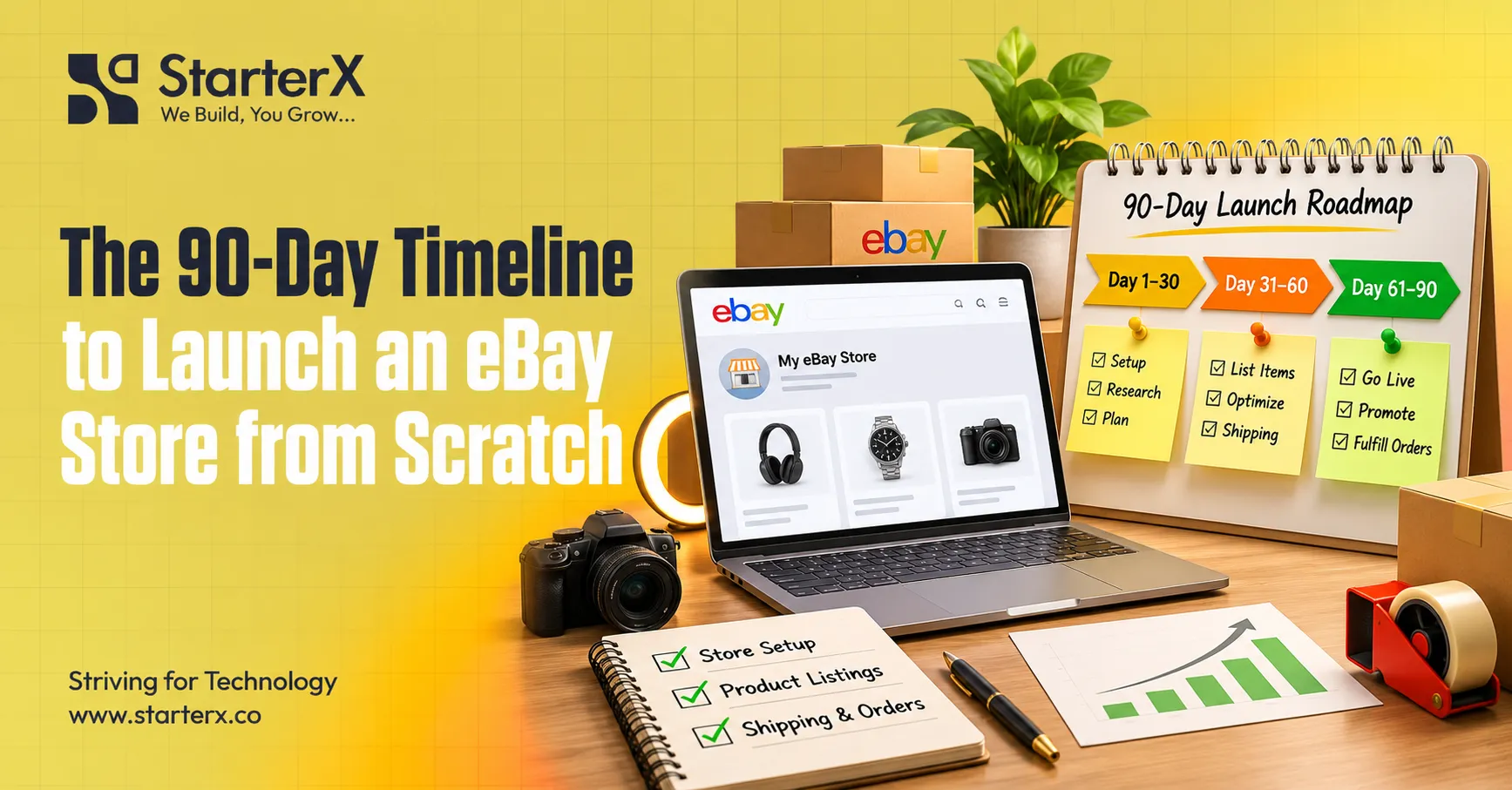
You can open an eBay seller account quickly, but building a store that customers trust takes preparation, testing, and consistent execution. A 90-day timeline gives you enough space to research demand, source manageable inventory, create strong listings, test fulfilment, and make decisions using real performance data.
The 90-day milestone also matters for seller performance. According to eBay’s official Seller Standards Policy, a US account must be active for at least 90 days before it can qualify for Top Rated status. Sellers must also meet transaction, sales, tracking, defect, and policy requirements.
Your goal should not be to publish hundreds of listings immediately. It should be to create an eBay Store that can fulfil every promise it makes.
Week 1: Build the Business Foundation
Week 1 is about clarity not inventory.
Create and verify your seller account, connect your payout method, review selling limits, and choose an initial product category. Decide whether you will sell new, used, refurbished, collectible, or open-box products.
Complete these foundation tasks:
- Choose a focused product category
- Establish a starting budget
- Define your target customer
- Review prohibited and restricted products
- Create initial shipping and return policies
- Select an inventory-storage area
- Prepare a basic profit calculator
- Review suitable Store subscription options
Do not select a subscription only because it sounds professional. Compare the monthly cost, listing allowance, tools, and category-specific fee savings against your planned selling volume.
By the end of Week 1, you should understand what you want to sell, who may buy it, and how much you can afford to risk.
Weeks 2 to 4: Research Products and Protect the Margin
Month 1 should produce evidence.
Use sold listings and product-research tools to study average selling prices, demand, competition, shipping costs, product condition, and sell-through behavior. Active listings reveal asking prices; sold listings reveal what buyers have actually purchased.
For every product idea, record:
- Average sold price
- Estimated sourcing cost
- Packaging and shipping
- Applicable eBay fees
- Advertising allowance
- Return-risk allowance
- Expected net profit
- Estimated selling time
A product selling for $200 is not automatically better than one selling for $40. The expensive item may require more capital, take longer to sell, cost more to ship, and create a larger financial loss if returned.
By Week 4, you should have a shortlist of products supported by real marketplace activity—not social media excitement.
Weeks 5 to 6: Source and Inspect Test Inventory
Begin with a small test order. Your first purchase is designed to validate the research, not consume your entire budget.
Inspect every product for:
- Correct model and specifications
- Cosmetic condition
- Functional performance
- Missing parts or accessories
- Serial numbers
- Authenticity concerns
- Packaging requirements
- Likely customer complaints
Create clear condition grades such as New, Open Box, Excellent, Good, and Acceptable. Define what each grade means so that your photographs and descriptions match the product buyers receive.
Record the complete landed cost, including the purchase price, transportation, repairs, cleaning, packaging, and labor. This reveals the actual margin behind each item.
Weeks 7 to 8: Build and Launch the Store
Now transform the inventory into a customer-ready eBay Store.
Create a professional name, logo, banner, description, and product-category structure. Customers should immediately understand what you sell and why they should trust your business.
Every listing should contain:
- A search-focused product title
- The correct category
- Complete item specifics
- An accurate condition description
- Original product photographs
- Measurements or specifications
- Realistic handling time
- Shipping and return information
Avoid vague descriptions and keyword stuffing. Use the brand, model, size, color, condition, material, compatibility, and other buyer-focused details naturally.
Start with a controlled number of accurate listings. Ten researched listings are more valuable than fifty rushed ones. Review every page on desktop and mobile before publishing it on the eBay Website.
Weeks 9 to 10: Test the Customer Experience
Your first sales test is more than your products. They test the complete operating system behind your store.
Use the same fulfilment process for every order:
- Confirm the payment and buyer details
- Match the product with the listing
- Inspect the item again
- Package it securely
- Select the correct shipping service
- Upload tracking within handling time
- Store shipping evidence
- Respond promptly to messages
Do not promise same-day handling if you cannot provide it consistently. A realistic promise fulfilled on time is better for account health than an ambitious promise followed by late shipping.
Monitor cancellations, returns, tracking, customer questions, and feedback. Each repeated problem reveals a process that needs improvement.
Weeks 11 to 12: Optimize and Prepare to Scale
By Week 12, early patterns should begin to appear. Separate your inventory into three groups:
- Winners to source again
- Promising listings to improve
- Weak products to discount or discontinue
Review impressions, click-through rate, watchers, offers, conversion, returns, advertising costs, and actual profit. Improve weak listings by testing the main photograph, title, item specifics, price, description, and shipping terms.
Do not place a large reorder because one unit sold. Look for repeatable demand and reliable margins before increasing inventory.
Create weekly procedures for sourcing, listings, fulfilment, customer service, account health, and financial reporting. By Day 90, the business should become less dependent on memory and more dependent on tested systems.
What Should Your Store Look Like on Day 90?
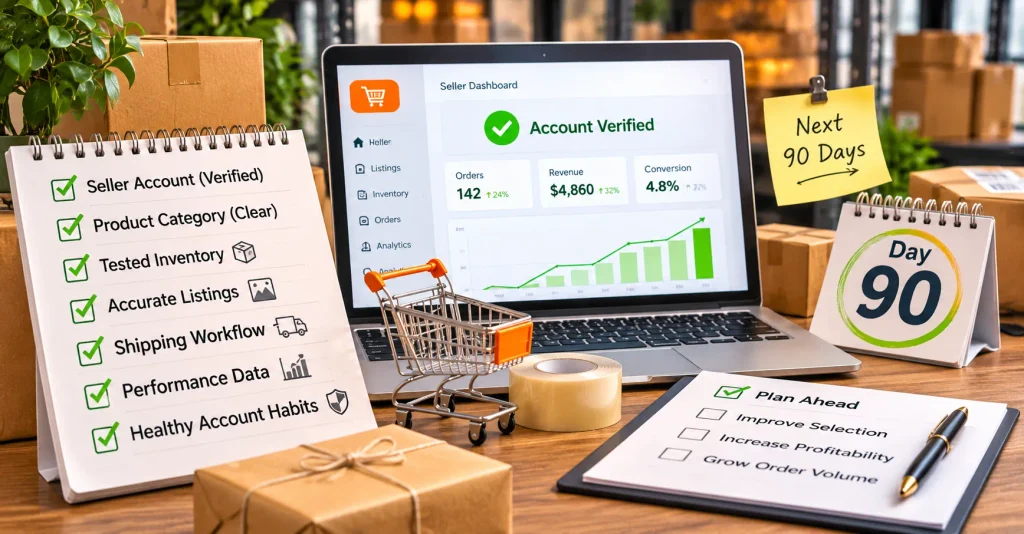
A successful Day 90 does not require hundreds of products or $10,000 in sales. It should give you:
- A verified and operational seller account
- A clear product category
- Tested inventory
- Accurate listings
- A repeatable shipping workflow
- Initial performance data
- Healthy account habits
- A plan for the next 90 days
The first quarter creates the foundation. The second quarter should use what you learned to improve selection, profitability, and order volume.
Why Choose StarterX for eBay Store Support?
StarterX is a B2B ecommerce partner that helps businesses establish and grow marketplace operations. Support can include account setup, product research, store development, listing optimization, operational planning, and performance improvement.
StarterX helps sellers Launch an eBay Store around market evidence, realistic margins, accurate listings, and repeatable fulfilment processes.
The Final Word
A successful 90-day launch is measured by more than the number of products published. It should teach you what customers buy, which listings convert, how much profit each order creates, and whether your fulfillment process can support growth.
Use Week 1 to establish the foundation, Week 4 to validate products, and Week 12 to scale proven opportunities. As orders increase, protecting your eBay seller account becomes essential for maintaining visibility, buyer trust, and sustainable marketplace growth.
Frequently Asked Questions
How can you make $10,000 a month on eBay?
To make $10,000 a month on eBay, sell about 250 orders at a $40 average for $10,000 in gross sales. For $10,000 in net profit, you need roughly $33,000-$40,000 in monthly sales at a 25-30% margin. Sellers get there with high-margin niches, repeatable sourcing, search-optimized listings and a Store subscription to cut fees.
How much does eBay take from a $1,000 sale?
On a $1,000 sale in most categories, eBay takes about $136.40: a 13.6% final value fee ($136) plus a $0.40 per-order fee. You keep about $863.60 before item cost and shipping. The fee applies to the total sale, including shipping and sales tax, and is lower for Store subscribers (about 12.7%) and some categories.
Who is eBay’s biggest competitor?
Amazon is eBay’s biggest competitor overall, with far larger sales volume and a huge third-party seller marketplace. Walmart Marketplace, Etsy and Facebook Marketplace compete in specific segments. Amazon dominates new, fast-shipping products, while eBay leads in used, vintage, refurbished and collectible items.
Is there a better selling site than eBay?
It depends on what you sell. Amazon is better for new, branded products with fast shipping. Etsy is better for handmade, vintage and craft items. Poshmark, Depop and Mercari suit secondhand fashion, and Facebook Marketplace suits local sales with no shipping. eBay remains stronger for used, refurbished, rare and collectible items.

The StarterX Team is a group of e-commerce experts with years of hands-on experience in launching, managing, and scaling online businesses. As trusted authorities in the e-commerce space, we’ve helped entrepreneurs grow successful stores on Amazon, Shopify, TikTok, and Walmart. Backed by real-world results and a data-driven approach, we deliver proven strategies and insights you can trust to succeed in the digital marketplace.