.svg)
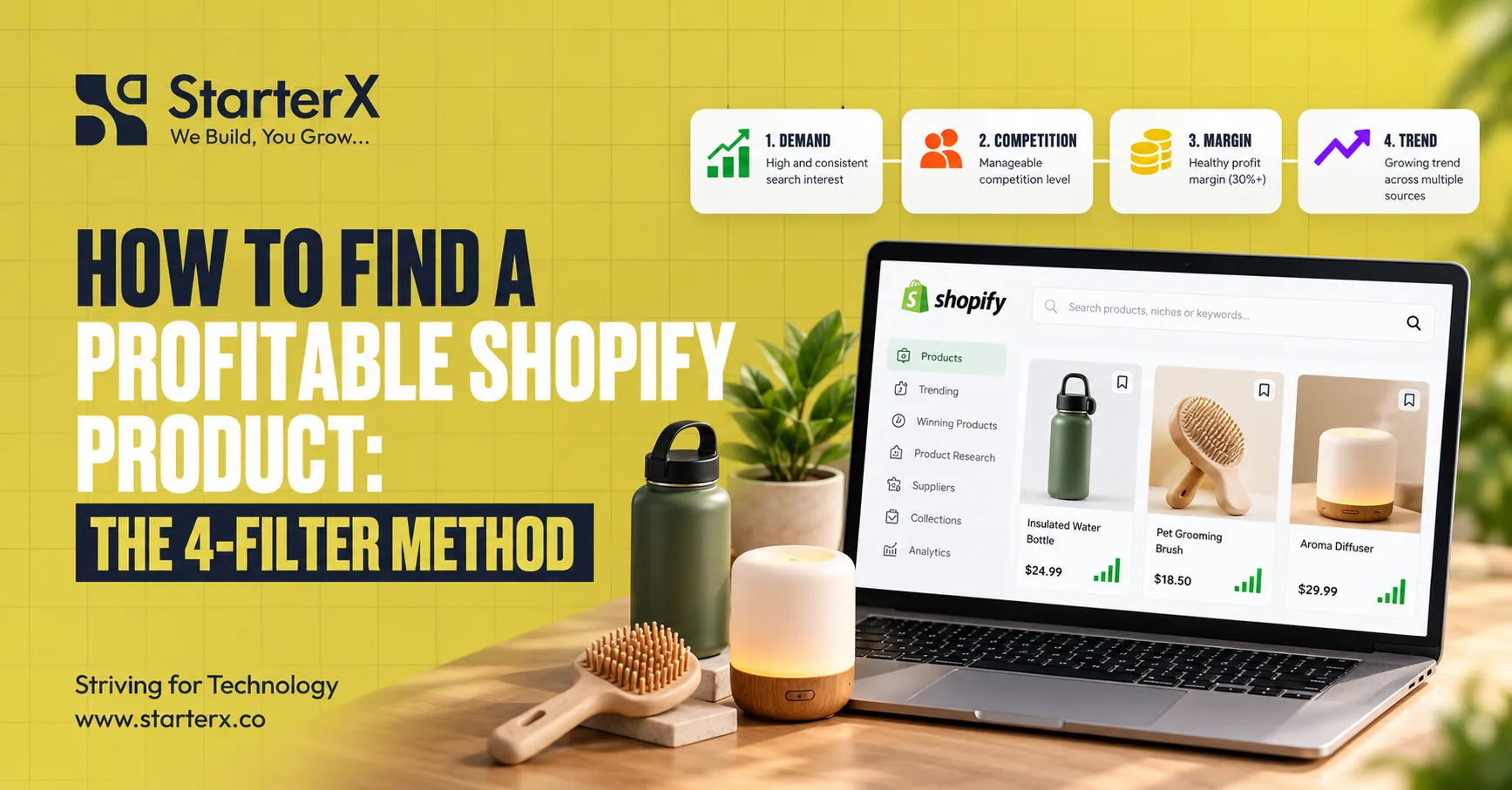
Finding a product to sell is easy. Finding one with proven demand, workable margins, reliable sourcing, and room to compete is where the real work begins.
Many beginners choose a Shopify product because it looks interesting, appears in a viral video, or is being promoted by another store. Those signals can generate ideas, but they do not prove that the product will create sustainable profit.
Shopify’s official product research guide recommends evaluating market demand, competitors, trends, customer needs, and potential profitability before committing to an idea. The goal is to replace assumptions with evidence.
The 4-filter method helps you do exactly that. Using an ecommerce intelligence platform such as ZIK Analytics or a similar product explorer, you can study established stores, narrow the results, and identify products worth validating.
The rule is simple: run every idea through all four filters and stop at the first meaningful failure.
Why Reverse-Engineer Proven Stores?
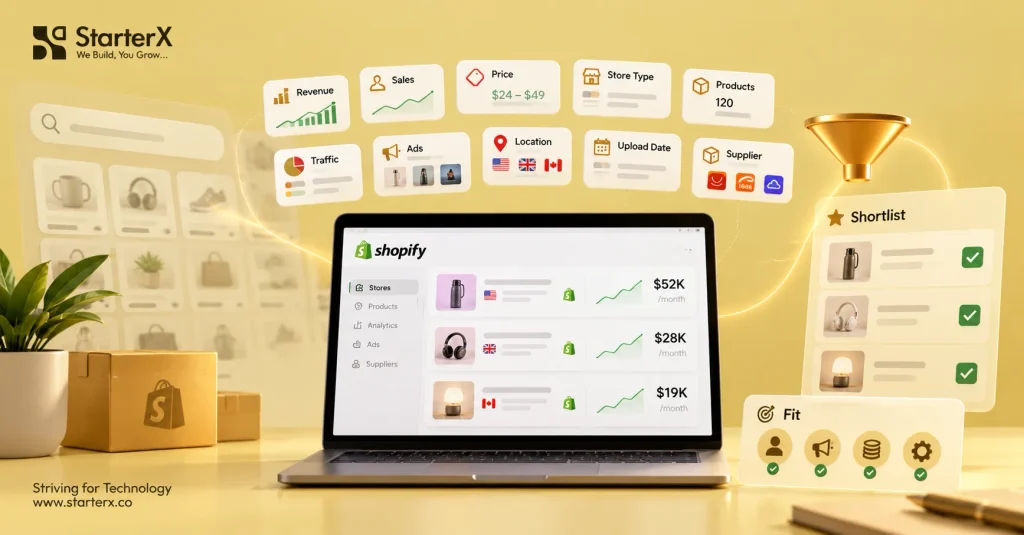
Starting with an empty search bar creates too many possibilities. Instead, begin with stores already generating estimated sales in your preferred market.
Product-research tools can help you examine:
- Estimated monthly revenue
- Recent sales activity
- Product prices
- Store type
- Product count
- Traffic sources
- Active advertisements
- Store location
- Product upload dates
- Supplier options
These figures are estimates based on publicly available signals, not audited financial records. Use them to find patterns and shortlist opportunities, not as guaranteed proof of future results.
A strong profitable Shopify product is not simply popular. It must fit your business model, marketing skills, available budget, and operational capabilities.
Filter 1: Store Type and Business Model
The first filter determines which businesses you are studying.
If you plan to build a one-product dropshipping store, comparing yourself with a large retailer carrying thousands of products will produce misleading conclusions. Its traffic, brand recognition, buying power, and customer retention strategy will be completely different.
Use the product explorer to isolate relevant models, such as:
- Dropshipping stores
- Single-product stores
- Niche stores
- Print-on-demand businesses
- Private-label brands
- Small curated catalogs
Then review how those stores position products, structure offers, display social proof, create bundles, and communicate benefits.
Ask whether you could realistically operate a similar model. A product may work inside a trusted multi-category retailer but fail when placed inside a new one-product store.
Pass condition: The product is succeeding within a store model you can reasonably replicate or improve.
Fail condition: Its performance depends on advantages your new business will not have.
Filter 2: Minimum Revenue Threshold
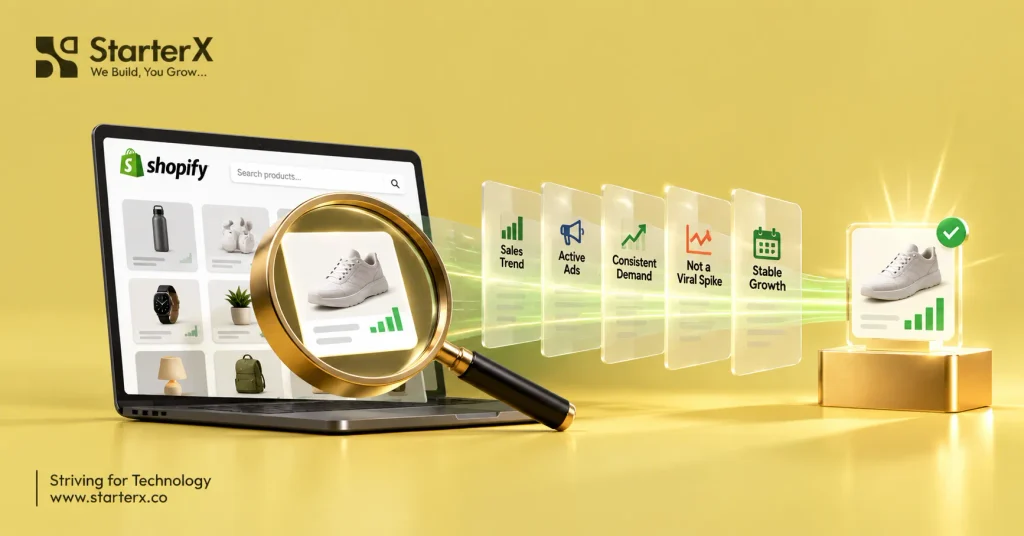
The second filter removes inactive, unproven, and low-performing stores.
Set an estimated monthly revenue floor, such as $10,000 to $15,000 over the previous 30 days. This does not guarantee profitability, but it can help you focus on stores with evidence of current customer demand.
Do not study revenue alone. Check whether sales:
- Appear consistent across several weeks
- Depend on one temporary viral spike
- Come from one product or the entire catalog
- Are supported by active advertising
- Are increasing, stable, or declining
- Follow a predictable seasonal pattern
If a store generated strong estimated revenue six months ago but now appears inactive, the opportunity may already be fading.
The best candidate is not always the product with the highest sales. A smaller product with stable demand and fewer competitors may be easier to enter profitably.
Pass condition: The product shows meaningful, recent, and reasonably consistent demand.
Fail condition: Demand appears weak, outdated, seasonal without a plan, or dependent on one unexplained spike.
Filter 3: Minimum Price Point and Margin
A store can generate impressive revenue while earning very little profit. That is why the third filter should focus on price and unit economics.
Set a minimum selling price of approximately $25 or higher. This creates more space to absorb sourcing, shipping, payment-processing, advertising, packaging, and return costs.
However, price alone does not create margin. Calculate:
Selling Price – Product Cost – Shipping – Transaction Fees – Advertising – Returns – Operating Costs = Estimated Profit
Imagine a Shopify product sells for $35. The product and shipping cost $13, transaction and platform-related expenses total $2, advertising costs $12 per purchase, and expected returns add another $2. Only $6 remains before overhead and taxes.
You should also test conservative scenarios. What happens if advertising costs increase by 20%? What if customers expect free shipping? What if the supplier raises its price?
Pass condition: The product maintains a healthy contribution margin after realistic expenses.
Fail condition: Profit only exists when every cost remains unusually low.
Filter 4: Niche and Traffic-Channel Fit
The fourth filter determines whether the product fits your planned customer-acquisition strategy.
A visually surprising product may perform well through short-form TikTok or Instagram content. A technical product may need Google Search, educational content, or detailed comparison pages. A giftable product may respond better to Meta advertisements during seasonal periods.
Use keywords or traffic filters to find stores operating in your preferred niche and marketing channel. Review:
- Active Meta advertisements
- Organic TikTok and Instagram activity
- Influencer partnerships
- Search visibility
- Content frequency
- Engagement quality
- Customer comments
- Offer and landing-page consistency
Do not copy another store’s advertisements or creative assets. Study the strategy behind them. Identify which customer problem is being highlighted, how quickly the product is demonstrated, and what offer encourages the purchase.
Pass condition: You can create content and campaigns suited to the product’s proven traffic channel.
Fail condition: The product requires a channel, budget, or creative capability you cannot currently support.
Complete a Final Risk Check
A product that passes the four database filters still needs independent validation.
Review:
- Supplier reliability
- Sample quality
- Shipping times
- Product restrictions
- Intellectual-property risks
- Return probability
- Customer-service complexity
- Product safety
- Packaging requirements
- Seasonal limitations
- Market saturation
- Potential for differentiation
Order and inspect a sample before placing a large inventory order or launching advertising. A successful competitor cannot protect your store from poor product quality or unreliable fulfillment.
You should also prepare your store carefully. Weak mobile design, confusing navigation, copied descriptions, slow pages, unclear policies, and complicated checkout experiences can prevent a promising product from converting.
Score the Products That Survive
Build a simple scorecard for every shortlisted product:
- Demand: 1 to 5
- Competition: 1 to 5
- Margin: 1 to 5
- Marketing fit: 1 to 5
- Supplier reliability: 1 to 5
- Risk level: 1 to 5
A product does not need a perfect score, but weak demand or unsustainable margins should usually be treated as a rejection. Emotional attachment should not override the numbers.
The 4-filter method is designed to eliminate weak options quickly so your time, samples, and advertising budget are reserved for stronger candidates.
From Profitable Product Research to Shopify Success with StarterX
Finding a promising product is only the beginning. Turning that opportunity into a profitable business requires reliable sourcing, competitive pricing, and a store experience that converts visitors into customers.
At StarterX, our Shopify Agency helps ecommerce businesses connect product research with supplier evaluation, profitability planning, store development, and growth strategies. By aligning these essential steps, we help sellers move beyond product discovery and build a stronger foundation for sustainable growth.
The focus is not just on identifying products with sales potential, but on creating a practical strategy to bring those products to market successfully.
The Bottom Line
A profitable Shopify product is not defined by viral attention, impressive estimated revenue, or a high selling price alone. It needs consistent demand, realistic profit margins, dependable sourcing, and a customer-acquisition strategy that fits your resources.
The four-filter method helps narrow your options by examining business-model fit, revenue consistency, profitability, and marketing compatibility. However, passing these filters is only the first stage. Supplier quality, fulfillment reliability, competition, and operational risks still require independent validation.
The strongest product opportunities are those supported by evidence rather than assumptions. Research carefully, test with a manageable budget, and use actual performance data to guide your decisions before scaling.
Frequently Asked Questions
How to find a winning product for Shopify?
Use product-research tools, competitor analysis, search trends, advertising data, customer reviews, and supplier research. Validate demand, competition, margin, marketing fit, quality, and fulfillment before launching. A winning product is discovered through testing, not appearance alone.
How to filter Shopify orders by product?
Open “Orders” in Shopify Admin and use the search bar to enter a product name or SKU. Shopify can display orders containing that search term. You can combine it with additional filters and save frequently used searches as custom views. For deeper performance analysis, use Shopify’s sales-by-product reports where available.
What sells fast on Shopify?
Products that solve clear problems, demonstrate well visually, match current demand, and have compelling offers can sell quickly. Common categories include beauty accessories, pet products, home organization, apparel, fitness items, gifts, and digital products. Category popularity does not guarantee profitability.
How do I organize my products in Shopify?
Use product categories, types, vendors, tags, and collections. Manual collections let you choose products individually, while smart collections can automatically group products using conditions such as price, tag, inventory level, or product type. Maintain consistent naming and tagging as the catalog grows.
Is Shopify still worth it in 2026?
Shopify can still be worthwhile in 2026 for businesses with a validated product, clear positioning, dependable operations, and a realistic customer-acquisition strategy. The platform provides ecommerce infrastructure, but profitability depends on the product, offer, traffic, conversion rate, customer retention, and margins.

The StarterX Team is a group of e-commerce experts with years of hands-on experience in launching, managing, and scaling online businesses. As trusted authorities in the e-commerce space, we’ve helped entrepreneurs grow successful stores on Amazon, Shopify, TikTok, and Walmart. Backed by real-world results and a data-driven approach, we deliver proven strategies and insights you can trust to succeed in the digital marketplace.